

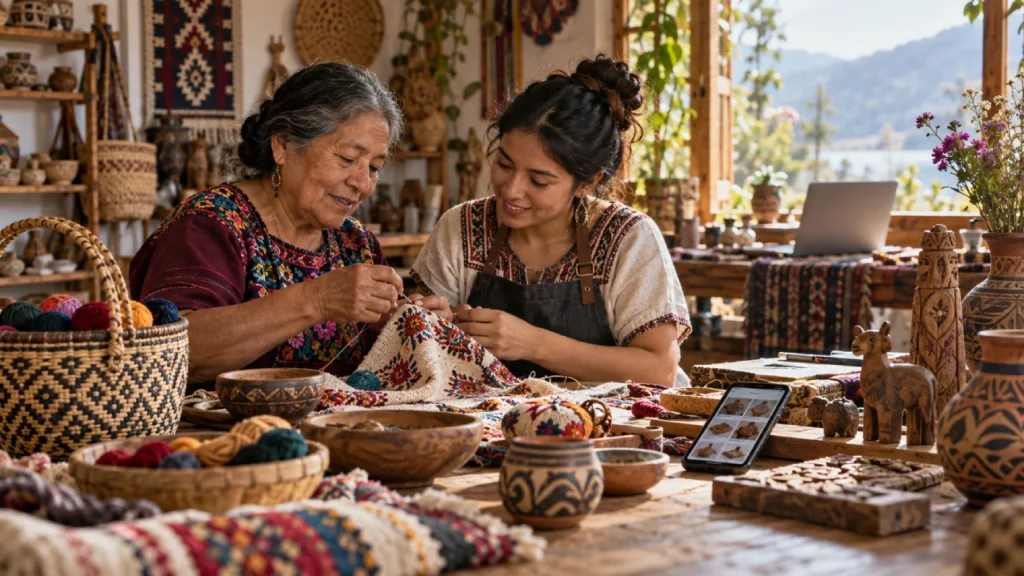
Culture has never travelled as quickly as it does today. It moves between continents in seconds via music, through film and even through fashion, which may take root in one place within days. While the advent of globalisation has provided incredible possibilities for cultural interaction, it poses an equally uncomfortable question: What happens to the cultures that cannot compete with the industrialised world of commoditised products?
One solution to this problem lies in local crafts. Whether it is textiles, ceramics or wood, metal, embroidery or basketry, traditional crafts are not simply handmade items; they are carriers of memory. The history of local communities, their environment, culture, occupations, and even lifestyle are all embedded in them. In today’s globalized world, which tends to strip all places of their uniqueness, local craftsmanship becomes especially important.
More Than Just Handmade Products
The craft item may seem quite straightforward: a shawl woven, a pottery vessel, a painted mask, or a wooden sculpture. But behind this object stands a chain of knowledge collected through ages.
The traditional craft usually requires skills gained through observation and personal experience, not through the study of textbooks. The craftsperson knows which local materials are most appropriate for a specific craft item, how long they need to be dried, which colors can be created with the help of natural dyes, and how the design is to be laid out according to traditions. Such knowledge represents a unique piece of cultural heritage.

The craft tradition, which manages to survive, gives an opportunity for such knowledge to be transferred from one generation to another. When the youngster learns to weave from his parents or grandparents, he not only learns how to make money. He gets acquainted with the whole lexicon of designs, techniques and stories.
Craft as a Living History
Culture is usually shared in the form of monuments, museums, literature and documents. However, culture can also live on through everyday items.
Textiles could preserve the visual vocabulary of the group. Pottery could help us understand how people ate, preserved,d or traded their food. Traditional jewelry could reveal the social standing of the people, and the patterns of embroidery could reflect the local beliefs, nature, and mythology.
All this turns craft into living history. In contrast to the artifact that is placed in the museum display case, traditional craft still lives due to its being made and recreated.

This is very significant. The preservation of culture does not imply the arrest of tradition in the past. Craft is still alive exactly due to the making process.
The Role of Local Identity
The processes of globalization have facilitated cultural exchange but have led to standardization as well. The same brands, items, and styles appear in all major cities on different continents. In opposition to this trend, local crafts stand out as representatives of their region.
A handcrafted item usually indicates the location of origin. The materials used for its creation may be specific to the local environment, whereas the design may refer to the region’s historical background. Even flaws may become features of such an item. Therefore, local crafts possess some cultural value which cannot be achieved by industrial production.
Think about the difference between an industrially produced item and a handcrafted one. The former will certainly cost less money and be more homogeneous, whereas the latter will carry something of the creator and his or her community. The creator’s touch is present, and the object has a history. Thus, purchasing a local craft becomes a way of cultural identification.
Crafts and Economic Survival
Culture cannot survive separate from the people who live it. Should the artisans not be able to make a sustainable living from their craft, it makes sense that younger generations might choose other careers. And here comes in the economic value of traditional arts.
Crafts can create job opportunities, especially in rural areas where there might be few others. In addition, crafts can sustain families, promote entrepreneurship, and allow women and small-scale producers to participate in the economy.
Moreover, tourism creates a market for local products. Tourists want to bring something to remember the place where they spent time, and local products can become the way to do that.
But there is a risk to this approach too. When a market is created by tourism, crafts might lose their authenticity and become stereotyped. And it is necessary to create economic value without distorting traditions.
The Digital World Can Become an Ally
Technology has often been seen as a threat to crafts, but there is also a chance for technology to preserve them in the digital age.
Social media can allow artisans to display their work to audiences that go far beyond their local marketplaces. Digital marketing could allow them to reach customers without depending on any intermediaries, and videos and digital archives could preserve some techniques that might otherwise be lost.
A craftsperson who was dependent solely on his local marketplace can suddenly have access to buyers all around the country – or the whole world.

It would change the dynamics of tradition vs modernity, too. A weaver will not have to sacrifice his traditions to be part of the global economy, because technology can provide him with a new marketplace. Technology can become not just a tool of homogenization but also of survival of culture.
Young People and the Future of Tradition
Perhaps the most challenging obstacle for traditional crafts is generational.
The youth might view professions in crafting as unprofitable, with hard-working environments or no chance of advancement. If they decide to abandon studying traditional skills, the knowledge built over hundreds of years can vanish in one generation.
Education can play an important role in transforming this stereotype. Educational establishments can teach the youth about local crafts not only as artistic but also as historical, technological, and entrepreneurial activities. Workshops with artisans will establish direct contact between the young generation and traditional knowledge.
On the other hand, artisans should be encouraged to innovate. The collaboration between traditional artisans and young designers can help develop products adapted to modern life without losing the core of their culture.
Tradition does not mean repetition. A craft can develop without losing its essence.
The Problem of Cultural Appropriation and Exploitation
The worldwide popularity of traditional handicrafts raises many tough questions as well. As certain designs, patterns, or methods become popular on an international scale, the people who originated them do not always benefit.
The designs could get copied by major producers and become available for sale at a much lower cost than what was charged by the artisan. Sometimes the designs are taken away from their original context and sold without any credit being given. This is why responsible consumerism becomes important.
One needs to question the origins of the item purchased and the amount paid to the producer. It helps promote economic gains from cultural appreciation as well. Protecting one’s culture should never mean protecting poverty.
A Bridge Between the Past and the Future
The real power of local arts is the fact that they can create connections across different generations.
An artisan who works in the present might apply the skills of the past in his work while selling his products via smartphone. A tradition could be depicted on the clothes of the contemporary age. The weaving skills of the past could attract customers through an international online market.
There is no contradiction here. Culture always evolves. Traditions do not stay the same because they change, evolve, and adapt themselves in order to survive.

In a global world, local crafts have a unique position. They are both old-fashioned and contemporary, local and increasingly international. Local crafts make it possible for communities to enter into the world of global culture while maintaining their uniqueness.
Conclusion
Globalization need not spell the end of local culture. Rather, the global world offers new chances to protect and promote cultures provided that communities are at the core of the process.
Cultural traditions are preserved and protected through local craftsmanship since they serve to conserve knowledge, reinforce identities, generate income and make history tangible. In every thread woven, surface painted, design carved, and object of clay, there lies an entire memory ready to be carried on.
Craftsmanship cannot be guaranteed for the future through the isolation of artisans from the realities of modern times. What needs to happen is the integration of the artisan’s knowledge within them.
Living in an increasingly homogeneous world, in which everything is the same, the handcrafted object stands out as something stubbornly unique – a testimony to its origin, maker, and ancestors alike. This is why local crafts are important – not just as historical artifacts but as living examples of culture that still influence the future.