

Highlights
- The Yo-Yo Intermittent Recovery Test, introduced to Indian cricket by strength and conditioning coach Shankar Basu in 2017, set a minimum benchmark of 16.1 for national selection, a number that fundamentally changed how Indian cricketers approached year-round conditioning.
- Fitness standards vary meaningfully by team, with England and New Zealand requiring a minimum Yo-Yo score of 19, while West Indies, Sri Lanka and Pakistan have historically set the bar at 17.4, proof that elite cricket fitness is a target shaped by team philosophy.
- The BCCI has shifted from the Yo-Yo Test to the more demanding Bronco Test in recent years, a move explicitly designed to match global fitness standards set by Australia and New Zealand and to promote year-round conditioning over pre-series fitness bursts.
- Hardik Pandya’s Yo-Yo score of 21.7 stands well above the Indian team’s qualifying threshold, illustrating the gap between minimum selection standards and genuine elite fitness.
- The biggest fitness lesson for young players is the underlying principle it enforces: both form and fitness are now evaluated together, and no amount of skill exempts a player from meeting a physical standard.
There was a time when cricket carried a reputation as a gentleman’s game—unhurried, tactical, more concerned with technique than with physical conditioning. But the modern game, particularly its white-ball formats, demands explosive power, repeated sprinting, split-second reflexes, and the ability to sustain peak intensity across long, draining sessions. Gone are the days when cricket was seen as a leisurely pursuit; today’s players sprint, dive, and bowl at top intensity multiple times within a single match, and the fitness infrastructure built around international teams reflects that shift completely.
For young players watching their heroes train, the most useful thing to study is why elite teams have made fitness a non-negotiable part of selection. The story of how India, Australia, England, and other top sides built their conditioning programs offers a genuinely instructive blueprint, one built less around secret exercises and more around discipline, consistency, and an honest relationship with physical standards.
The Yo-Yo Test: Cricket’s Most Influential Fitness Benchmark
If there is one assessment that has reshaped how the sport thinks about conditioning, it is the Yo-Yo Intermittent Recovery Test. The test involves two cones placed 20 metres apart, with the player running between them in sync with a beep played through an audio track, the pace accelerating progressively until the runner can no longer keep up with the required tempo. What makes it particularly relevant to cricket is that it actually measures how quickly they recover between repeated high-intensity efforts, be it a near-perfect mirror of the stop-start, sprint-and-recover rhythm of running between wickets and covering ground in the field.
The test arrived in Indian cricket in 2017, introduced by strength and conditioning coach Shankar Basu, with then-coach Anil Kumble making it mandatory for selection. The Indian team set a qualifying benchmark of around 16.1 to 16.5, with later discussion about raising it further to 17. What followed was described by observers as the beginning of a new era of healthier, more muscular Indian cricketers, a generational shift in how players approached their bodies as professional athletes.

The standard is not universal, and that variation is itself instructive. England and New Zealand have set their qualifying benchmark at a notably higher 19, while West Indies, Sri Lanka and Pakistan have historically used 17.4 as their threshold, with West Indies Cricket explicitly confirming a minimum score of 40 on their Yo-Yo Test scale (equivalent to 17.4) as a requirement for national team selection. Bangladesh briefly moved away from the Yo-Yo Test toward the simpler beep test before reintroducing it in 2021 with a benchmark of 18.6, brought in specifically to bring the country’s testing protocols in line with the rest of the cricketing world.
For a young player, the lesson embedded in these numbers is that every elite team has decided that a quantifiable, repeatable fitness standard matters enough to gate selection on it. Talent alone has stopped being sufficient.
When Fitness Cost Players Their Place: The Selection Lesson
Sanju Samson was once left out of the Indian squad for failing to clear the fitness benchmark. He returned to domestic cricket, improved his conditioning, and came back to the national setup stronger and more consistent. Ambati Rayudu’s exclusion from the 2019 World Cup squad was similarly linked to fitness concerns, despite ongoing debate about team balance. Hardik Pandya, returning from a back injury, was not permitted back into the Indian squad until he had cleared the minimum fitness level required by the Yo-Yo Test, a delay that applied regardless of his standing as a top-performing all-rounder.
These examples carry a specific lesson for young players. Form has never been enough on its own, and in the current cricketing landscape, it no longer travels alone. Players now understand that selection is based on a combination of form and fitness, which keeps everyone accountable and reduces the kind of complacency that used to let an established star coast back into the team after injury purely on reputation. The system has shifted from one where a recognized name could return to the side post-injury without question, to one where every player must first prove match readiness by clearing a defined physical standard.

It is worth noting that this system is not without its critics. Some observers argue that uniform fitness benchmarks do not account for position-specific physical demands, as a fast bowler naturally requires a different conditioning profile than a spinner or a wicketkeeper, and that rigid standards can occasionally sideline gifted players whose value lies in skills the test does not measure. That tension is worth understanding:t fitness testing is a tool. But even accounting for that critique, the overall direction across world cricket has been toward higher physical standards.
The Bronco Test: Raising the Bar Further
India’s cricketing fitness journey did not stop with the Yo-Yo Test. In recent years, the BCCI has shifted its primary endurance assessment to the more rigorous Bronco Test, a deliberate move designed to match global fitness standards set by countries like New Zealand and Australia and to promote a culture of year-round conditioning.

The Bronco Test, which several senior Indian cricketers have described as tougher and more transparent than its predecessor, places even greater demand on sustained aerobic capacity and repeated-sprint ability. The shift reflects something important about how elite teams approach conditioning, where standards are not static. As the physical demands of the format evolve and T20 cricket in particular has compressed explosive effort into shorter, more intense windows, the benchmarks used to prepare for it evolve as well. A young player training today against yesterday’s fitness standard is, in a sense, training for a version of the game that no longer exists.
What Elite Conditioning Programs Actually Involve
Behind the headline test scores sits a structured, multi-component training approach that any aspiring young cricketer can draw lessons from, even without access to a national board’s resources.
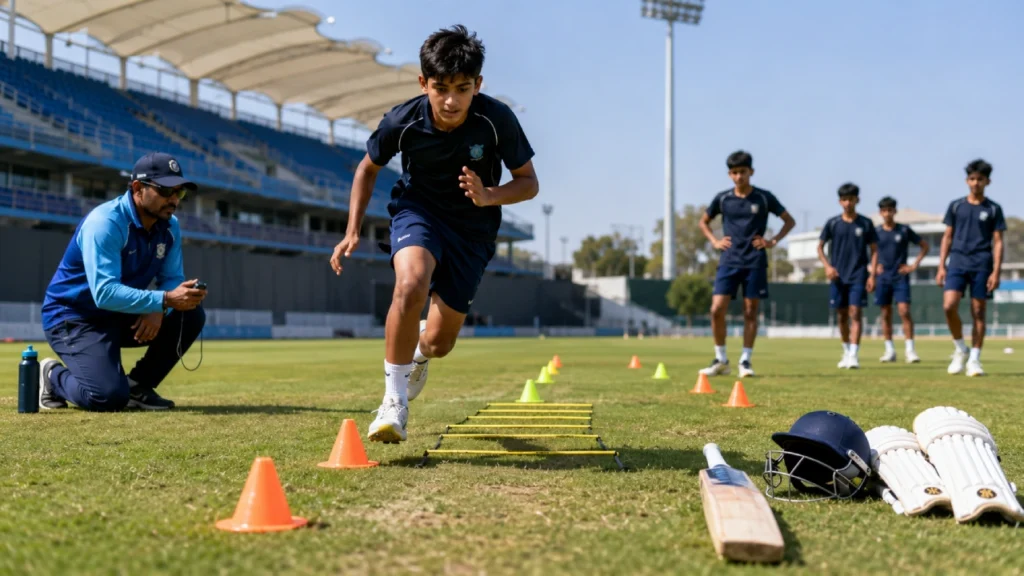
Speed and agility work (shuttle runs, cone drills and short sprint repetitions) form the foundation of in-match movement: the ability to turn quickly between wickets, close down ground in the field, and accelerate into a bowling run-up without losing control. Strength training built around fundamental compound movements, including squats and deadlifts, supports the muscular endurance that allows a player to maintain bowling pace, batting power and fielding intensity deep into a long innings or a demanding spell. Interval-based conditioning, including high-intensity interval training, builds the specific stamina profile cricket actually requires: the ability to repeat short, intense efforts with incomplete recovery.
Equally important, and often the most overlooked component by younger players building their own training routines, is recovery itself. Proper hydration, deliberate nutrition planning, and adequate rest are treated by professional conditioning staff as performance interventions in their own right. A player who trains hard but recovers poorly will plateau, and often regress, regardless of how disciplined their gym sessions are.
The Real Lesson for Young Players
It would be easy for a young cricketer to look at numbers like Hardik Pandya’s reported Yo-Yo score of 21.7, well above India’s qualifying threshold, and conclude that the takeaway is simply to train harder. That is true, but incomplete. The more important lesson sitting underneath every story of fitness-related selection and conditioning reform in international cricket is structural, for fitness in 2026 is a part of cricket.

Upcoming players are increasingly expected to focus on strength, stamina and agility from an early age, which is producing a generation of more professionally conditioned athletes earlier in their development than previous generations experienced. For a junior player, the practical implication is that conditioning should be a year-round discipline, built the same way international teams have built it through consistent, structured training; honest fitness assessment; and recovery practices that are taken as seriously as the training itself.
What to Watch Next
As white-ball cricket continues to compress and intensify, expect fitness benchmarks across international teams to keep climbing rather than plateauing, following the same trajectory that took Indian cricket from the Yo-Yo Test to the Bronco Test. For young players and the coaches developing them, the clearest signal from the top of the sport is that technical skill will always matter most, but it is no longer evaluated in isolation. The cricketers setting the standard today built their games on the understanding that elite skill needs an elite body to deliver it consistently, year after year. That is the lesson worth taking from the top of the sport down to the academy nets.