
Highlights
- Home workouts remove the usual obstacles to fitness, like time, costs, or gym anxiety.
- Simple bodyweight exercises can boost strength and stamina over time.
- For beginner fitness, consistency tends to matter more than workout intensity, even if the sessions feel small.
- Walking, squats, push-ups, and planks help you build a solid foundation.
- Finally, sustainable habits support long-term fitness success, not just quick results.
Beginner home workout: Fitness has become more accessible lately. For years, exercise was tied to pricey gym memberships, complicated gear, and workouts that felt hard to stick with, even if you wanted to. But now there is this noticeable move toward simpler, more grounded ways of moving.
More people are realizing that staying active does not really need a gym, fitness gadgets, or a big block of free time. Sometimes, you just need a small space at home, comfy clothing, and that steady willingness to keep moving, even if it’s not perfect.
This feels pretty relevant in today’s routines, where long work hours, packed calendars, school responsibilities, and family duties can make exercise seem, honestly, like a hassle to fit in. Whether you’re a student, someone in a professional role, a homemaker, an entrepreneur, or an older adult, workouts at home can be a practical route to build healthier habits without adding extra tension.
Maybe the best part of training at home is that it removes a lot of the early obstacles that usually stop people. There’s no travel time, no costly equipment to buy, and no stress about keeping up with other folks.
In the end, fitness becomes more personal, a bit more flexible, and easier to fold into daily life, little by little.
Why Beginner Fitness Should Focus on Consistency
One of the most common misconceptions about exercise is the idea that a good workout has to be intense, or just totally exhausting. But for beginners, it is mostly consistency that makes the real difference. The body needs time to adjust to movement, build endurance, and develop strength, step by step, not all at once. When people start with routines that are unrealistic, it usually turns into heavy soreness, then irritation, and then later they just stop, completely.
So a fitness routine that can actually last should feel more doable than scary. Even if it is only twenty to thirty minutes of movement, a few times per week, that can still raise energy levels, improve flexibility, support cardiovascular health, help posture, improve sleep quality, and boost your overall wellbeing.
At the start, you are not trying to be perfect. The point is simply to build the habit of moving regularly and keeping it there.

Start Your Home Workout With a Five-Minute Warm-Up
Every workout starts with a warm-up. Warm-ups help blood circulation increase gradually. They loosen those stiff muscles and get the body ready for actual movement. Also, this crucial step tends to lower the chance of discomfort and injuries, which is always good.
For a beginner, a simple warm-up could look like this, nothing fancy really:
- March in place for about one minute
- Gentle neck rolls, plus shoulder rotations
- Arm circles
- Side bends
- Hip rotations
- Light leg swings
- Ankle rotations
The point is not to drain your energy, it’s more about waking things up, so injuries are easier.
Step One: Brisk Walking In Place
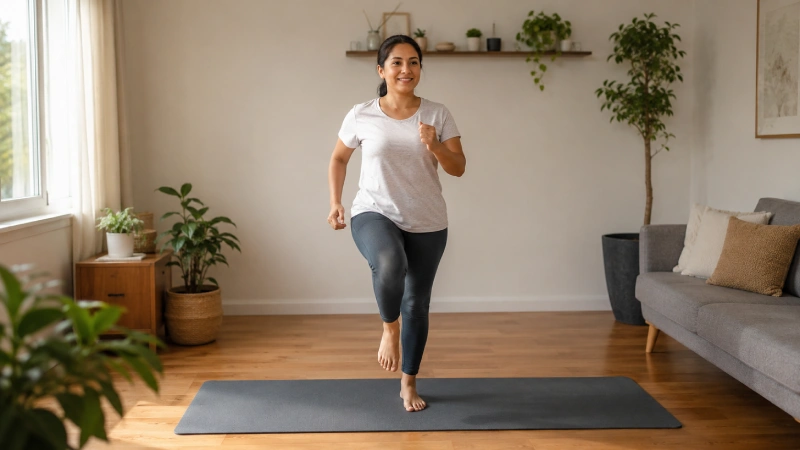
Walking is one of the most overlooked exercise options. For beginners, brisk walking in place works really well when you want better cardiovascular fitness without putting too much stress on your body. It nudges your heart rate up gradually, and it also helps with coordination and endurance.
Start with walking in place for three to five minutes. If you feel okay, you can slowly lift your knees a bit higher and pick up the pace. And if you like it, listening to music while you do it can make the whole thing feel less boring.
Walking seems simple on its own, but if you do it regularly, it really adds up and supports your overall fitness.
Step Two: Bodyweight Squats for improving strength
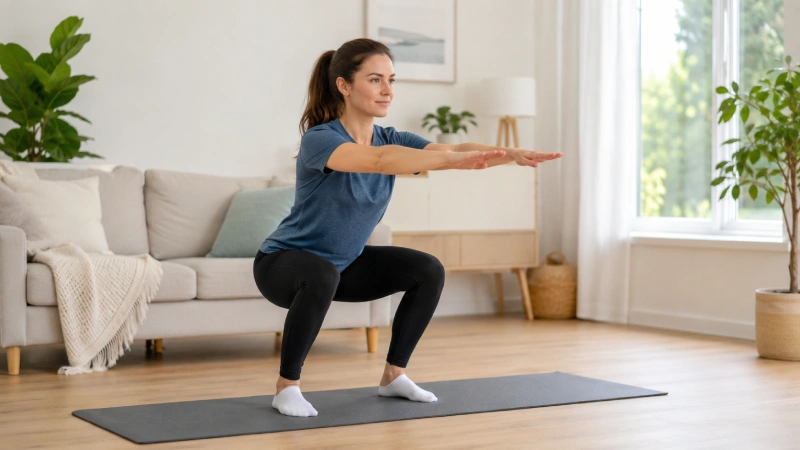
Squats are one of the most useful exercises for building strength in the lower body. They hit the thighs, glutes, hips, and core, while also helping with stability and everyday mobility. For beginners, just start by standing with your feet about shoulder-width apart, then slowly drop into a sitting motion like you’re relaxing into an imaginary chair. Keep your chest up, and make sure your knees track the same direction as your feet.
To begin with:
Two sets of 10 reps
If full squats feel a bit rough at first, partial squats are totally fine. The main idea is steady progress, not chasing flawless technique on day one.
Step Three: Wall Push-Ups
Regular push-ups can feel daunting, especially at the start. Wall push-ups, on the other hand, are a solid alternative, since they build up the chest, shoulders, arms, and general upper body strength without putting too much stress on the joints.
Stand facing a wall, place your hands around shoulder height. Then slowly bend your elbows to slide your torso toward the wall and push back up.
Start with:
Two sets of 10 repetitions
As you get stronger, you can shift from wall push-ups to incline push-ups, using a steady table or countert op, if it feels safe.
Step Four: Glute Bridges for Core and Lower-Back Support
Sitting for long stretches often leads to weaker glutes, plus a bit of lousy posture over time.
Glute bridges strengthen the hips, the lower back, and the core, all while boosting stability and range of motion.
Lie on your back with knees bent and feet flat on the floor. Slowly lift your hips up, pause for a moment, then lower again.
Start with:
Two sets of 10 repetitions
This drill is especially helpful for office workers and students who end up seated most of the day.
Step five: Bird Dog Drill for Balance and Coordination
Balance often gets less airtime than strength or cardio, but it’s honestly just as important.
The bird-dog helps your stability, gives you better coordination, improves posture, and works the core pretty directly.
Start on hands and knees, then slowly reach one arm out and the opposite leg out too while you keep yourself steady. Hold it there for a few seconds, then switch sides.
Do this:
Eight reps on each side
This routine pushes controlled motion, and it also helps with body awareness, in a kind of quiet way you can feel over time.
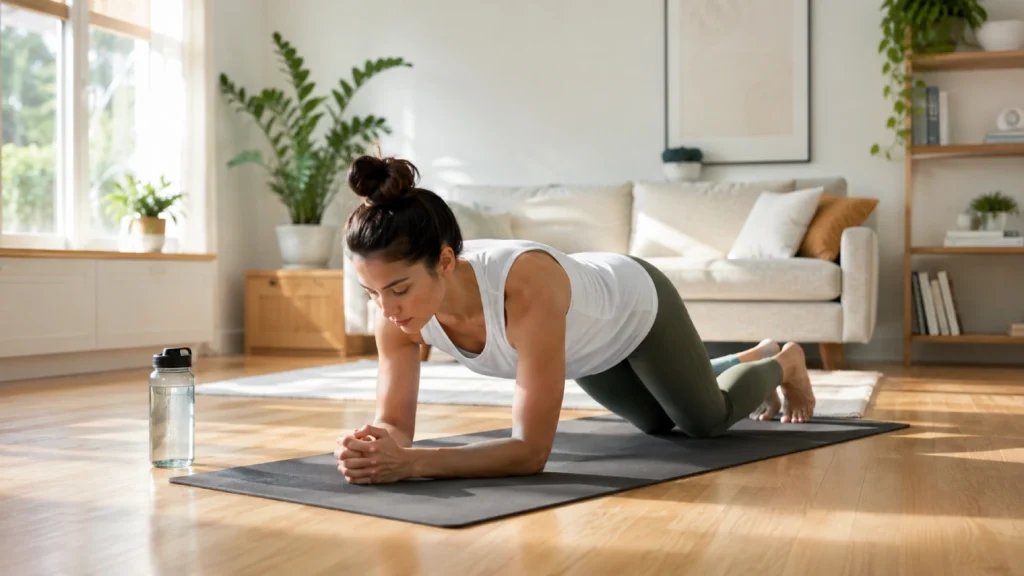
Step Six: Planks for Core Strength
Core strength supports almost every everyday action. When your core is stronger,r you can usually notice better posture, less back discomfort, steadier balance, and movements that feel smoother through the day.
Beginners can begin with a modified plank, resting on the knees and forearms instead of going straight up.
Hold for: Fifteen to twenty seconds
Repeat: Twice
As you get stronger, the time can rise bit by bit.
Progress matters more than the exact duration at the start, so don’t obsess.
End Each Session with Gentle Stretching
Cooling down matters as much as warming up, not less. Stretching lets the body settle; it boosts flexibility a bit, and it can ease muscle tightness after you exercise.
Try spending about five minutes on things like:
- hamstring stretches
- quadriceps stretches
- shoulder stretches
- gentle forward bends
- deep breathing exercises
Also, ending workouts slowly can create a calmer transition instead of stopping suddenly, which kinda feels jarring.
A Simple Weekly Routine for New Beginners
For beginners, the plan can stay pretty simple. This routine is :
- Monday: full-body workout and stretching
- Tuesday: a twenty-minute brisk walk
- Wednesday: full-body workout and stretching
- Thursday: gentle yoga or mobility exercises
- Friday: full-body workout and stretching
- Saturday: walking and stretching
- Sunday: rest and recovery
Overall, this routine keeps you moving without overwhelming you right away.
Why Rest and Recovery Matter
Most people kind of skip over recovery, and then wonder why progress feels slow. Muscles need time to adapt after you exercise, like they don’t just “switch on” instantly. Rest days let the body handle repair, and it builds strength bit by bit- twenty minutes at a time- in some sudden way.
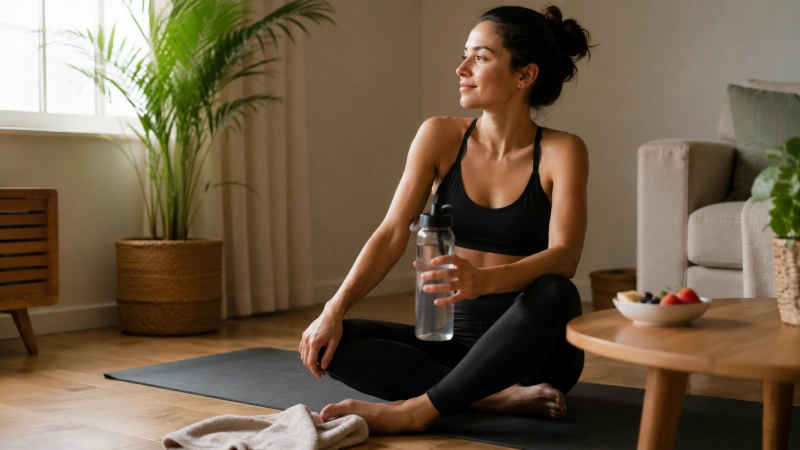
Sleep also matters a lot for fitness progress. When sleep is poor, you can feel it in energy levels, motivation, recovery, and even your overall performance, when you feel tired in a way that everything is heavier. And it’s not only sleep; hydration plus balanced meals also support workouts by helping you maintain energy and muscle function.
Fitness doesn’t really exist alone from lifestyle habits. Sleep, hydration, nutrition, and movement all work together, even if it doesn’t seem obvious day to day.
Understanding Calorie Deficit: The Foundation for Healthy Weight Loss
A lot of beginners start working out mainly to lose weight. Movement definitely helps, but many specialists keep coming back to the same idea: sustainable weight loss usually relies on keeping a calorie deficit.
A calorie deficit happens when your body spends more energy than it gets from food and drinks. Then, over time, the body leans on stored energy reserves, and that can lead to weight loss. Still, a calorie deficit is not the same thing as eating extremely little or pushing workouts to the point of exhaustion.
In fact, modern fitness approaches often lean toward moderate, steady habits, instead of extreme rules.
For beginners, a reasonable plan might look like this:
- Walking for 30 to 45 minutes on most days, if possible
- Choosing meals that are protein-forward, plus fiber-rich foods
- Drinking enough water
- Making sure you get adequate sleep
- Staying away from overly restrictive diets that are difficult to keep up with, long-term
Small Progress Is Still Progress
Honestly, the most important lesson for beginners is realizing that fitness is not some kind of race. Social media will show these huge workout routines and dramatic transformations, so it can make exercise feel intimidating, or basically impossible. But the truth is, real, meaningful health changes usually come from small things done over and over again, not from some sudden leap.
Like walking for about twenty minutes, doing a couple bodyweight routines, or exercising three times a week might feel pretty minor. Still, those exact small habits tend to build the base for your long-termwellbeingg. It’s not flashy, but it adds up in a quiet sort of way.
Modern fitness seems to be drifting away from extremes and toward sustainability. And exercise really does not need to be complicated to work.
Conclusion
Starting a fitness journey without any equipment is really doable and, honestly, easier than a lot of people seem to think. You can just walk in place, do squats, try wall push-ups, glute bridges, bird dog moves, planks, and include stretching. It’s kind of simple, but it works as a base for stronger muscles, more range of motion, and better cardiovascular fitness.
For students juggling school, professionals dealing with long workdays, homemakers handling the day-to-day chores, and entrepreneurs who always seem booked solid, home workouts bring something pretty important: access.
The best workout routines are rarely the most intense ones. Usually it’s the routines that blend naturally into regular life and that make consistent push-ups realistic.
And maybe that’s the whole point of beginner fitness. It doesn’t start with pricey gear or super complicated plans. It starts with one decision: to move a little more today than yesterday.